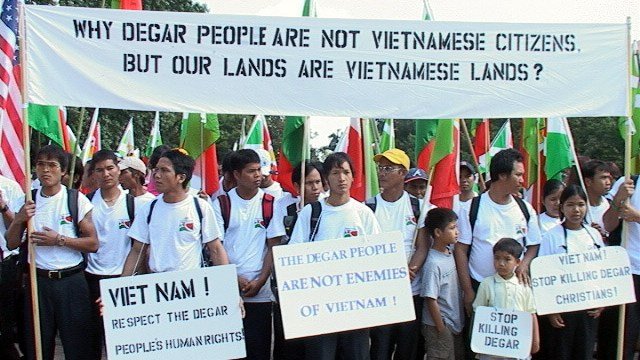
For over 30 years, the Vietnamese Government have continued to subject the Degar people, a peaceful ethnic minority Christian group, to arbitrary arrests, beatings and forced denunciations of their religion, with little or no repercussions at all. Seeking political autonomy and freedom to practice their religion, outside of the communist rule, the Degar people face continuous oppression and restrictions to living their lives, every day.
Updated October 2026. This page brings together what is known about the persecution of the Degar (Montagnard) people of Vietnam’s Central Highlands: who is targeted, the methods used, the key events since 2001, what United Nations bodies and independent human rights groups have found, and the individual cases documented on this website.
Who are the Degar, and why are they targeted?
The Degar, known under the French colonial term “Montagnards”, are the indigenous peoples of Vietnam’s Central Highlands, made up of around 30 ethnic groups such as the Jarai, Rade (Ede), Bahnar, Koho and Mnong. You can read more about their history and identity on our page Who Are the Degar?.
Three issues sit at the root of the persecution. The first is land: since 1975, state-sponsored migration of ethnic Vietnamese settlers and the expansion of coffee and rubber plantations have taken over ancestral Degar land. The second is religion: many Degar are Protestant or Catholic Christians who worship in independent “house churches” rather than in state-approved congregations. The third is history: Degar men fought alongside United States forces during the Vietnam War, and the authorities still treat many Degar as politically suspect because of that history.
The government describes much independent Degar worship as “Dega Protestantism”, which it calls a cover for a separatist political movement rather than a legitimate faith. In practice, that label has been used to justify arrests, surveillance and forced renunciation campaigns against ordinary believers. The Montagnard Foundation has repeatedly stated that it does not seek to overthrow the Vietnamese government or to separate Degar lands from Vietnam – see the MFI Statement of Clarification.
How the persecution works
Forced renunciation of faith
Degar Christians are regularly summoned to police stations or public meetings and pressured to sign documents renouncing their faith or to join the state-sanctioned Evangelical Church of Vietnam. Those who refuse face fines, beatings or prison. In 2011, Y-Huong Nie was sentenced to five years in prison after refusing to sign a renunciation document.
Raids on house churches and prayer services
Security forces have broken up Christmas celebrations, Easter gatherings and ordinary Sunday services. Examples documented on this site include the November 2010 attack on a Catholic prayer service in Gia Lai province, the December 2010 Christmas crackdown, the July 2011 attack on worshippers in which 12 people were beaten unconscious, and the August 2012 mass raid on a prayer vigil in Kontum province.
Arrests, torture and deaths in custody
Reports gathered from the Central Highlands describe beatings, electric shocks, and the use of attack dogs during interrogations, as in the case of two young men from Gia Lai province in January 2011. Several prisoners have died in custody or shortly after release, including Ksor Tino in September 2010 and Y-Kap Ayun. Human Rights Watch reported in 2011 that more than 350 Montagnards had been given long prison sentences on national security charges since 2001.
Pressure on families and returned refugees
The authorities have also targeted relatives of activists and refugees. Kok Ksor’s elderly mother, Ksor H’Ble, was repeatedly harassed and beaten until her death in 2011 (A Mother’s Silent Pain). Puih H’Bat, the wife of a resettled refugee, was arrested in April 2008 for leading prayer services in her home and has not been heard from since. Degar who were sent back from Cambodia have reported interrogation and torture on their return (see this 2007 report).
Loss of ancestral land
Land confiscation and resettlement into “fixed field, fixed residence” zones have pushed many Degar families onto poor farmland. In November 2023 the UN Committee on the Elimination of Racial Discrimination (CERD) raised concerns that indigenous communities in Vietnam had been evicted from ancestral lands with only minimal compensation.
Key events since 2001
- February 2001 – thousands of Degar demonstrate peacefully across the Central Highlands for the return of ancestral land and religious freedom. Military units are deployed and dozens of organisers are later imprisoned.
- April 2004 – renewed Easter week protests are violently dispersed. Human Rights Watch reported that several Montagnards were killed and many more injured, and hundreds of Degar fled to Cambodia in the months that followed.
- 2008 – a wave of peaceful protests calls for the release of prisoners. Arrests follow, including Puih H’Bat.
- August 2010 – the authorities launch a “wipe out” operation against Christians outside the state church (follow-up report).
- February 2011 – Cambodia closes the UN refugee centre for Montagnards in Phnom Penh (Human Rights Watch statement).
- February 2012 – Kok Ksor addresses the CERD 80th session, and the committee highlights a pattern of racial discrimination in Vietnam.
- December 2012 – Degar villager Siu Klong is tortured and hanged, with no effective investigation.
- June 2023 – after armed attacks on two commune offices in Dak Lak province in which nine people were killed, around 100 Montagnards are prosecuted. In November 2023 CERD experts asked whether terrorism laws were being applied disproportionately to ethnic minorities.
- November 2025 – Thailand extradites Y Quynh Bdap, a Rade (Ede) activist and UN-recognised refugee, to Vietnam despite warnings from Amnesty International that he faces a serious risk of torture.
What the international community has said
Independent organisations have documented the same pattern for more than two decades. Human Rights Watch’s 2011 report Montagnard Christians in Vietnam: A Case Study in Religious Repression describes public renunciation ceremonies and long prison terms for unregistered worship. In 2023 the UN Committee on the Elimination of Racial Discrimination said it had received “a large volume of credible reports” of efforts to prohibit religious and cultural activities, including officials trying to force people to renounce their faith.
Elected representatives have also spoken out: the European Parliament, the Italian Chamber of Deputies, Australian MP Luke Simpkins and US Senators Richard Burr and Thom Tillis, whose 2016 resolution called on Vietnam to respect the human rights of the Montagnard people. For the legal standards Vietnam is expected to meet, see the UN Declaration on the Rights of Indigenous Peoples and our page on Degar aspirations and indigenous rights.
Documented cases on this website
Each report below was received from the Central Highlands and published at the time of the events:
- Special Report on the Systematic Persecution of the Degar People (2004)
- Degar Christian Dies after Two Years of Torture in Vietnamese Prison (2007)
- Vietnam Still Targeting Christians (2008)
- Vietnamese Police Abduct Another Degar Montagnard Christian (2010)
- Authorities Threaten the Widow of K’Pa Lot (2010)
- 10 Degar Christians Beaten for Their Faith (2010)
- Vietnamese Security Police Torture Degar Christian (2010)
- Degar Christian Tortured – Fears Police Retaliation (2010)
- Dead or Alive? Vietnam Continues Persecuting Degar Christians (2010)
- Montagnard Men Beaten During Interrogations (2011)
- Vietnamese Civilians Attack Degar Family With Machete (2011)
- Security Forces Beat Relatives of a Christian Prisoner (2011)
- Authorities Interrogate So-Called “Illegal” Christians (2012)
- Vietnam Continues to Persecute Degar Christians Regardless of International Law (2012)
Older annual reports are collected in the Special Reports Archive and the 2003 Human Rights Report.
Frequently asked questions
Are Degar Christians allowed to worship in Vietnam?
Worship is permitted only inside registered, state-approved organisations. Degar who meet in independent house churches risk fines, arrest and pressure to renounce their faith, as the cases above show.
Is the persecution still happening today?
Yes. The UN anti-racism committee raised fresh concerns about religious restrictions, land confiscation and the treatment of Montagnards in November 2023, and activists who fled abroad have continued to face pressure, including the extradition of Y Quynh Bdap from Thailand in 2025.
How can I help?
Share documented cases with your elected representatives, support organisations that monitor religious freedom in Vietnam, and contact us if you have information about Degar prisoners or refugees.
Further reading
This page originally introduced an article published by Restless Beings: The Persecution of the Degar People. For analysis of how Hanoi has presented its record abroad, read The Myths and Propaganda of Hanoi.